Deaf Culture I: Overview
Lets play a game. We’ll call it “Guess who is deaf?” From the picture below tell me who you think is a deaf person:
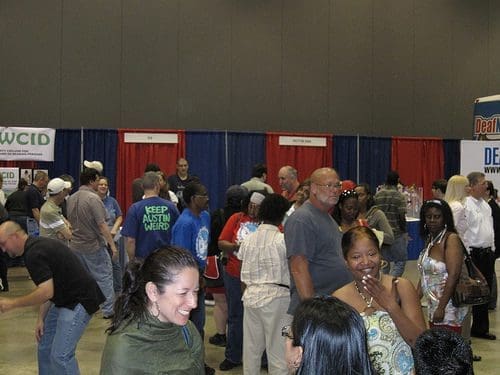 Give up? This a photo from an event called the Deaf Nation Expo. The one I went to this past April was compromised of about 90% Deaf people. Chances are just about everyone in that picture is Deaf. Can you tell? No. So comes our first lesson about Deaf Culture: most Deaf people co-exist with Hearing people completely unnoticable
But wait, Matthew, is it politically correct to call them “deaf”? No. Its not. One problem, most people who are deaf prefer to be referred to as–drum roll please–deaf (some may also prefer to be called hard-of-hearing). And so begins the struggle between the Deaf and the hearing worlds.
 Unbeknownst to many, deaf people have their own unique culture and identity. When referring to this culture or a person who identifies with this culture it is appropriate to refer to them as Deaf (capital D).
It may be hard for us to fathom, but those who are Deaf see nothing wrong with themselves. In fact, many Deaf people are proud to be deaf. This might seem odd, and to be honest, I have yet to fully understand this mindset. But I’ve seen it best described as: not focusing on what they can’t, and focusing on what they can. Contrary to popular belief, Deaf co-exist in our hearing world and many Deaf people are very successful. The Deaf have developed their own art, literature, poetry, communities, language (American Sign Language in American and most of Canada), and yes, even their own music.
Without delving into the complexities of American Sign Language (along with other natural sign languages), the important thing to know is that ASL is its own unique language uniquely developed by the Deaf for the Deaf. ASL is revered by the Deaf community and although not all deaf people or Deaf people sign, its one of the most important products of Deaf culture
[youtube]hKnF9CCYQPQ[/youtube]
So what is so special about Deaf culture? A lot (real concise, right?). Well, for one thing the Deaf value community. Why? Because they need each other. They can communicate freely and together teach other how to live in a world that’s not very friendly to them. They share their stories, their struggles, their accomplishments–just like any other community.
The Deaf also value sharing information. It can be a little unnerving first for those of us in the hearing world. Maybe it arises out of having communication repressed and oppressed, because out of that has risen a culture where they share details about everything.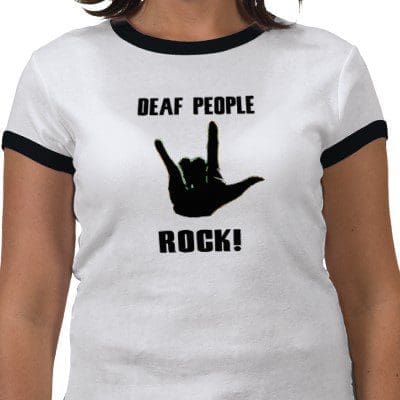
One example off the top of my head: if you’re late, Deaf people would not be satisfied with a simple “sorry, I’m late”. They’d want to know the details of it for sheer curiosity sake. When they introduce each other they may even give summarized life histories. In a deaf class and need to go to the bathroom? In the hearing world, we’d slip away quietly without saying a word. In the Deaf World information is valued highly.
Deaf people are very adamant about passing their culture on to the younger generations. You see, Deaf people are proud of their culture. They are proud of their accomplishments. It might be surprising to know that for about 100 years there were people who tried to stamp out the Deaf and Deaf culture. People called oralists tried to stamp out the usage of signing and force Deaf people to speak. That’s like asking a blind person to sign! In this post, I’ll avoid going into this topic in-depth.
Amazingly, 90% of deaf children are born to hearing parents. 90% of deaf parents have hearing children. This means that many members of the Deaf World do not inherit it from their ancestors, but rather find it (or stumble into it) at some point in their life. Deaf Adults are also very welcoming of others children, and will become like second parents. Raising children in the Deaf community is a community effort. When Deaf parents have a Deaf child it is seen as a positive event. Whereas many hearing parents see it as a tragedy, most Deaf people welcome it. Why? Because its seen as an opportunity to pass on their cultural identity to another generation. Not only this, but the parents will also be able to share their experience growing up deaf with their child and offer them opportunities they themselves may have been denied.
But I digress, this is a lot of information. I’ll be creating future posts detailing specifics in greater detail and hopefully provide some further references. Amazingly, I’ve only begun to touch on this topic.
Liked what you read? Subscribe for free.
Never miss out — Be notified of my latest articles!


Thanks Matthew, this helps me to understand the deaf culture more, even if I have no clue what is it like to be deaf.
I have deaf friends here in Mexico. I don’t know how it works in other parts of the world but here it is somewhat different. First of all, my friends have no problem being called deaf… We even joke about it. They have quite a sense of humor.
They also don’t consider the world to treat them bad or unfairly. At our school, I call one of my friends “V.I.P” because everybody knows him and wants to learn mexican sign language in the class he teaches.
Still, there are many problems concerning the deaf community in Mexico, mostly for people living in poverty.
I enjoyed learning from a different deaf culture. Thanks!
thanks. i have deaf friends at school and my signing is still a little shaky. this helps me to better understand what is like to.