Review: “Chainsaw Man”
I recently watched the first season of Chainsaw Man, an action Shonen anime by Tatsuki Fujimoto and produced by MAPPA. Here is a rundown of the plot along with my thoughts:
Plot
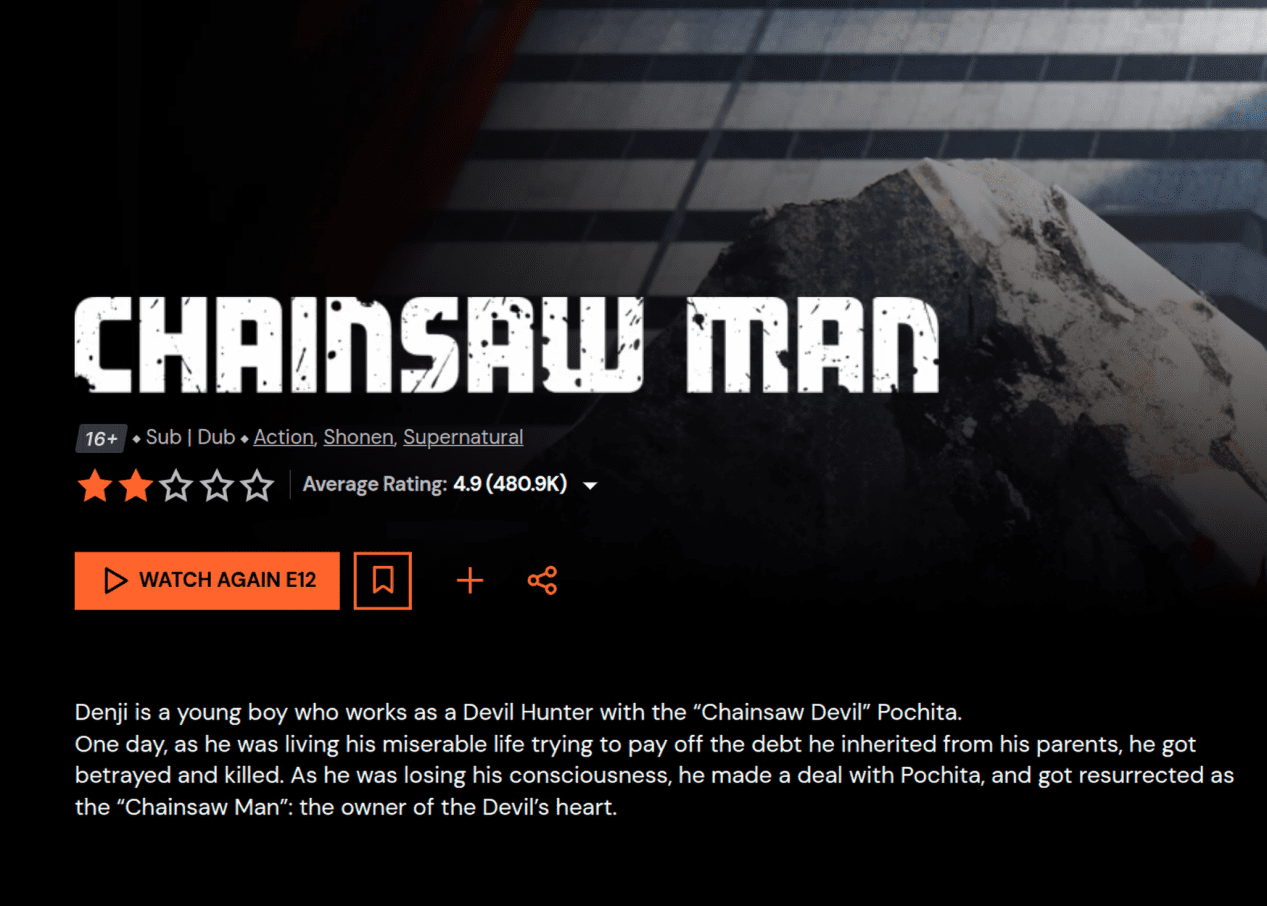
The show is about Denji, a boy who lost his family and inherited their debt. As a young boy he saved the life of a “Chainsaw Devil” Pochita, in return for its services killing demons. Denji spends his childhood, through the first episode, living in a shack, hunting demons to payback the Yakuza.
Denji is killed and brought back to life by Pochita who takes the place of his heart, imbuing Denji with the ability to transform into a “Chainsaw Devil.”
Through very anime-y events, Denji is taken captive by a public agency for hunting demons. While all of his needs are now met, Denji is obligated to hunt demons for them and obey their commands under penalty of death
Review
While the animation was top notch and certain aspects of the story were compelling, the character motivations of Denji — the show’s protagonist — are largely shallow and uncompelling. While that’s advertised as a feature of his difficult upbringing, they don’t particularly map to a believable psychological profile.
A young man who lived his entire life fighting demons just to put food on the table isn’t going to suddenly shift to immature pursuits of lust. Maslow’s hierarchy doesn’t work like that and neither do trauma responses. Rather than a rational working of psychological responses, it seems like Fujimoto is selling the audience on sex (“fan service”) and cheap laughs while cutting the legs off what could be a truly rich and compelling character.
The complicated interactions and conflicts of a boy who learned to only think about himself as a survival instinct while fighting demons and putting food in his stomach, while simultaneously developing deep feelings for the people who are manipulating him as a human weapon serve as a far more intriguing character tapestry than a teenage boy whose main motivation is copping a feel. We have a young man who exchanged one form of slavery for another, and Denji shrugs it off. His entire backstory and the events which bring him to his current place in the story are plot devices to create lusty encounters with busty women and violent bloody battles with hordes of zombies.
At the same time we’re supposed to take this immature boy with shallow convictions seriously as the show’s protagonist, Fujimoto hopes we’ll take the series as serious Shonen, shoehorning deep emotional beats. Amid the awkward teenage groping, we experience brutal carnage and gore, moments of pure hopelessness, death, and loss. Unfortunately, most of the characters are too hysterical or unbelievable for the audience to ever find a surrogate for the loss. Bad things happen, but you have a hard time feeling bad — because most of the characters don’t either.
Conclusion
In the end, the show felt like what amounts to “cheap calories.” You’ll get caught up in the action, flashy animation, and interesting character dynamics, but once you’re done with the ride wonder whether it was actually worth your time — It probably wasn’t.
Liked what you read? Subscribe for free.
Never miss out — Be notified of my latest articles!