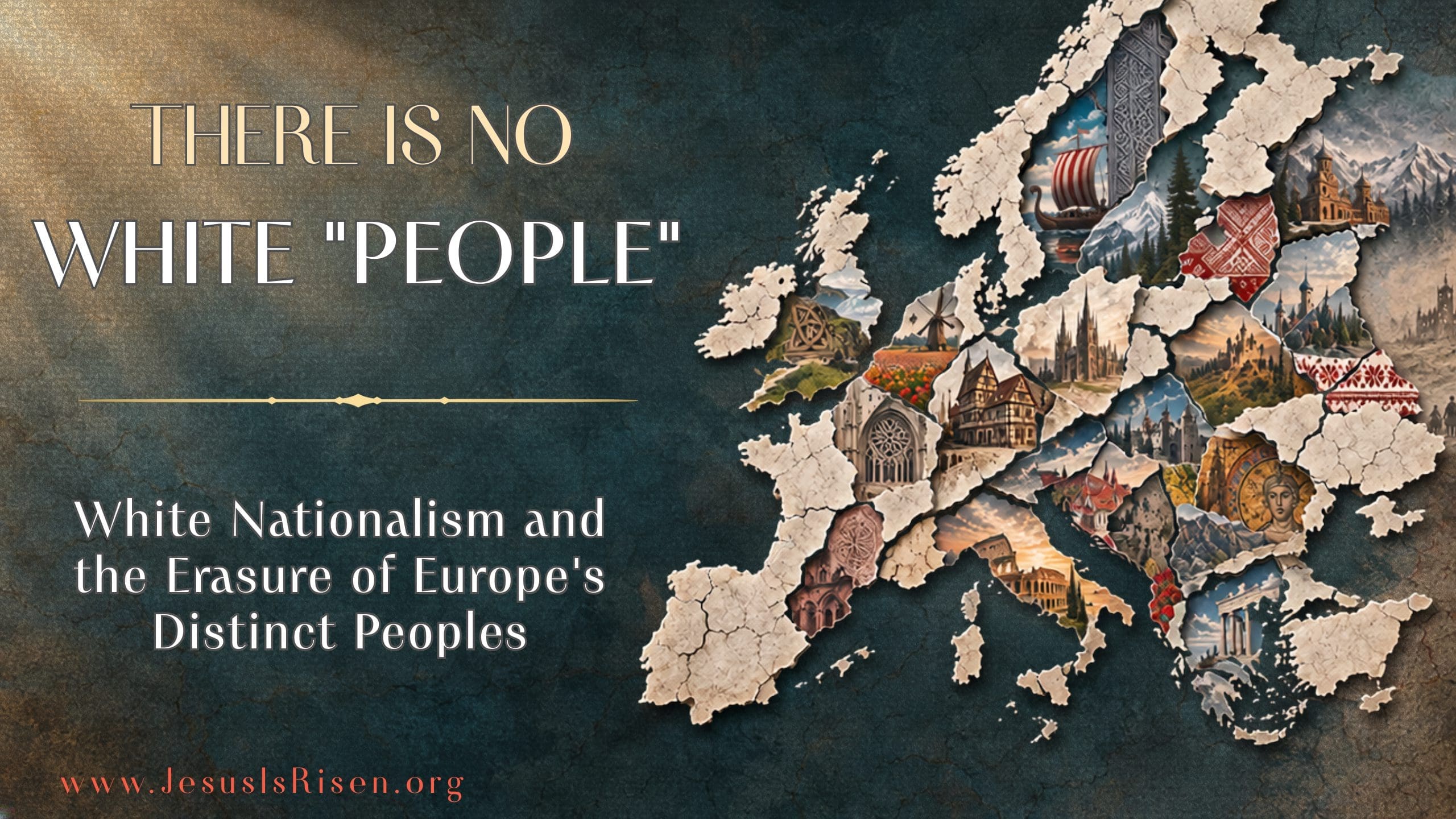
There Is No White “People”
White Nationalism and the Erasure of Europe’s Distinct Peoples
The question of the hour is: “Why can’t White people have a nation?”
The question assumes there exists a White people — a people with a common origin, tradition, and language, capable of constituting a nation-state (Merriam-Webster, n.d.).¹ But who are these White people? What common history, culture, and national identity unite them? And who gets to decide who belongs?
The answer is not the “slam dunk” one might think.
The European Question
Claimants of a unified White culture appeal to Europe. Europe? Where is this White nation in Europe?
“The instinctive consciousness which presided over the construction of the map of Europe,” wrote the French historian Ernest Renan, “took no account of race, and the leading nations of Europe are nations of essentially mixed blood” (Renan, 1882/1990, pp. 8–22). That quote is an excerpt from Renan’s 1882 lecture What Is a Nation?
Europe is not one people with one history. Its nations have their own languages, cultures, loyalties, and memories — often shaped by millennia of conflict with one another. Yet these are the peoples now being gathered beneath the banner of a supposedly unified White nation.
And here’s the irony: At the same time White nationalists call for a unified White nation, some also celebrate Balkanization — the fragmentation of a larger nation into smaller, frequently hostile nations.
For those unfamiliar with geography and history, the Balkans are a region of Europe known for their brutal, bloody ethnic — mostly White-on-White — and religious — Christian-on-Christian — infighting.
Mmm. Doesn’t that just fill you with a sense of pride, heritage, and the warm fuzzies?
Who Is a White Person?
Who qualifies as White? Historically, the answer has shifted with the cultures, prejudices, and interests of those defining the category. Those with the power to define it also have the power to exclude. Consider:
- Are you White?
- Are you Hispanic or non-Hispanic White?
- Are you “founding stock,” a “Heritage American,” or an “Ellis Island” White?
- Are you Northern, Southern, Eastern, or Western European?
- Do you speak English?
- Anglo-Saxon, Latin, or Slavic?
What principle stops the division?
The Answer Is Nothing
When the purpose is the exaltation of the self and the idolatry of the ethnos (the ethnic nation), nothing stops those who hold influence and power from flexing it to carve up the White nation. The same fervor that excludes the Hispanic today can exclude the Italian tomorrow, and the Pole after him, until what remains is a “Germanic nation” — or whatever the majority in power happens to be.
While claiming everyone who opposes them is a liberal, they openly flaunt intersectionality — the critical theory-adjacent framework that perpetually divides people into increasingly smaller groups.
Why Can’t White People Have a Nation?
Which brings us back to the question we started with: Why can’t White people have a nation? Because there has never been a homogeneous “White people” to form one. And to that end, no, there has never been a homogeneous Black, Red, or Yellow people either. While the topic of this article is “White people,” and the examples given are of related histories, parallels can be found in the histories of all of Adam’s fallen children. While skin color can be a useful, if crude, identifier, it is useless as a foundation for a people and nation.
It is, in the most insidious way, a betrayal of history and heritage and a means to erase the rich history of the peoples of Europe. Reducing them to a singular “White” removes our providential heritages — irony. Within a single country, cultures differ wildly. To claim the Englishman, the Slovenian, and the Russian share a “common origin, tradition, and language” is an insult to reality. The experience of a Greek family along the Mediterranean is radically different from that of a Bavarian German family. Likewise, both differ from the French fur traders who pushed into Northern Canada in the 1700s who married into First Nations peoples and gave rise to the Métis. Even that “White” line is mixed.
Too often, these distinct peoples are reduced to a single “White” culture that has never existed, defined by whoever happens to lead the movement.
Partition of Poland-Lithuania
We begin with the partitions of the Polish–Lithuanian Commonwealth. Once one of the largest and most influential states in Europe, its internal political structure contributed to a state that could not protect itself — or its people. A series of partitions by its White European neighbors — Prussia, Russia, and Austria — resulted in its complete dissolution in 1795.
Two important parts of my family originate from both the German- and Russian-controlled partitions of Poland. In the decades following the partitions, Prussia and Russia pursued policies of Germanization and Russification that suppressed Polish culture, language, and national identity. These were attempts by White European powers to extinguish the distinct culture of another White European people.
My White Polish ancestors had their country invaded and taken from them by White European powers that claimed Christian authority, and their culture subjected to repression.
Who Is White? Ask the Court
In the early 1920s, as Congress worked toward the sweeping immigration restrictions that would become the Immigration Act of 1924, the Supreme Court tried to answer the question most think is obvious: Who is a White person? Federal law allowed only “free white persons” and persons of African descent to naturalize. The Court had to decide what “white” actually meant.
In Ozawa v. United States (1922), Takao Ozawa, a Japanese-born man who’d lived decades in America, argued he should count as White. The Court first set aside skin color as the test, admitting it would produce “a confused overlapping of races and a gradual merging of one into the other, without any practical line of separation.” The Court reached for a racial label instead: “white person” meant a person of what is popularly known as the Caucasian race. Ozawa was not Caucasian, so he was not White.
Three months later, in United States v. Bhagat Singh Thind (1923), that standard produced the wrong answer. Thind, an Indian Sikh and a U.S. Army veteran, was Caucasian by the anthropology of the day — yet the Court ruled he was not White. The scientific classification the Court had relied upon just three months earlier was no longer sufficient. Color couldn’t define White. Label couldn’t define White. Whiteness, the Court said, must be interpreted “in accordance with the understanding of the common man.”
The common man of 1911 read the Dillingham report — Congress’s own study of immigration — and saw Italians and Poles as separate races. The common man of 1924 voted to keep them out. The common man of 1939 Germany saw Poles as Untermenschen — “subhumans,” in the language of Nazi racial ideology. In every era, “a white person is a white person” felt obvious. Yet, in every era, that line of “obvious” constantly crept.
A nation must know who its members are. A nation built on a category no one can define hands the definition to whoever holds power — and whoever holds that power can change the answer. Membership in a White nation is never secure. It is provisional, held only as long as one stays inside a line that history shows will move.
The patriotic “pro-White” social media montages common in ethno-nationalist circles, promising “we’ll all someday have a home,” feel warm and fuzzy, stirring feelings of patriotism, pride, and loyalty, but it’s a bill of goods. The “we” is arbitrary, undefinable, and easily divided.
The Immigration Act of 1924
The Immigration Act of 1924 specifically targeted Eastern and Southern Europeans — Italians, Poles, Greeks, and Slavs — just to name a few. White people. This was a response by White Anglo-Saxon natives who feared the White Eastern and Southern European immigrants. Had the law been enacted 10 years earlier, four generations of my “White” family wouldn’t exist.
The law pegged its quotas to the 1890 census — before the great wave of Southern and Eastern European immigration — and cut that region’s quota by 87 percent. Italy’s annual immigration quota alone fell from 42,057 under the 1921 law to just 3,845 under the 1924 law (Chishti & Gelatt, 2024; U.S. Bureau of the Census, 1970, p. 91; United States Holocaust Memorial Museum, n.d.-b).
The groundwork had been laid by the Dillingham Commission, whose 1911 report sorted Europeans into distinct races and ranked Northern and Western Europeans above Southern and Eastern ones. That same report’s Dictionary of Races or Peoples opens by admitting that authorities could not agree on how many races there were, with proposals running as high as 63, and that anthropology and ethnology were “not far enough advanced to be in agreement” (U.S. Immigration Commission, 1911, p. 3).
The report adopted five races anyway and divided the White race into “a multitude of smaller ‘races’ or peoples” on “a linguistic basis.” The reason was convenience: an inspector “may easily ascertain the mother tongue of an individual,” but he had neither the time nor the training to classify the shape of an immigrant’s head (U.S. Immigration Commission, 1911, pp. 3–4). The “races” that ranked Italians below Englishmen were whatever an Ellis Island inspector could write down.
That line has not disappeared. In ethno-nationalist circles today, “heritage Americans” — descendants of colonial, founding stock — are ranked above the Ellis Island wave and its children, almost exactly where the 1924 quotas drew the line. The State Department’s own historians describe the law’s purpose as preserving “the ideal of U.S. homogeneity” (Office of the Historian, n.d.).
I, a White person, am both. One side of my family is founding stock; the other came through Ellis Island from Poland. Which half of me counts? Do my grandparents deserve death, Corey Mahler?
In the restrictionists’ minds, the Europeans being kept out were a different race of people.
The Massacre of My People
In 1939, Nazi Germany and the Soviet Union invaded and occupied Poland. They proceeded to murder millions of Poles and engage in the systemic destruction of their culture, burning millions of records and books. Villages my family came from no longer exist because the majority of the population was murdered. What remains today are ruins, and monuments to the Holocaust in Israel bearing the village’s name.
Not Just the Jews
Many assume the Nazi war machine was aimed only at the Jews. It was not. Nazi racial ideology also classified Poles — my family and kinsmen — and other Slavic peoples as inferior, labeling them Untermenschen — subhumans. Generalplan Ost envisioned clearing tens of millions of Slavs from the East to make room for German settlement (Evans, 2010). The U.S. Holocaust Memorial Museum estimates the Germans killed at least 1.8 million non-Jewish Polish civilians, alongside some 3 million Polish Jews (United States Holocaust Memorial Museum, n.d.-a, n.d.-c). Priests, teachers, and community leaders were rounded up and shot to decapitate Polish society (United States Holocaust Memorial Museum, n.d.-c).
Genocide Against “Whites”
Himmler’s plan for the remaining population (Himmler, 1940) was to educate them enough to count, write one’s name, and obey White Germans. White Polish children judged “racially valuable” were taken from their families to be raised as Germans (United States Holocaust Memorial Museum, n.d.-c). This was a White nationalist regime ranking White Europeans as a lesser race and acting on it. The same racial partiality that excluded White Europeans in America justified their persecution in Nazi Germany.
The Mercies of the Wicked Are Cruel
Ethno-nationalists have half of it right: The “liberal post-war consensus” depicts Adolf Hitler and other Nazis as mustache-twirling villains. But the implication here is that this means they were milder, compassionate, fighting for survival against a world that just wouldn’t leave the poor White German nationalists alone. Reality is far uglier.
Neither side of the “post-war consensus” argument has room for my family. They were predominantly Roman Catholic Poles. The liberal story has too often left the non-Jewish Polish dead in the background, and the revisionist right waves the war’s crimes away entirely. My family belongs to neither group’s myth. I cannot tell you how many of my relatives died, but I know the communities my family came from suffered terribly. Their people were persecuted and murdered for being Slavs.
The men who carried out the war were not cartoons.
Warning: The following paragraphs contain gruesome details of historical atrocities.
In 1941, Himmler watched a mass shooting near Minsk and was shaken; he was told the shooters would be ruined for life (Lifton, 1986). That concern helped drive the search for methods that would spare the killers. Gas vans were one answer (Beer, 1987). White Germans would put White Poles (Jewish and Non-Jewish) in the back of a van. The exhaust of that van would be fed through into the back compartment. They would drive that van until the exhaust killed the people in the compartment. However, the sounds of the White people knocking and screaming for help were too heavy for the SS soldiers driving the vans. This is one of the reasons why the gas chambers would eventually be chosen, both for their efficiency in killing and to reduce the stress on the murderers (Lifton, 1986).
The same perversion of compassion extended even to infants. Under Nazi racial policy, foreign slave laborers from Eastern Europe were subjected to classifications determining whether their children were considered valuable to the German people or threats to its racial future. The regime’s 1943 abortion policies subjected pregnant Eastern workers to racial examinations, with decisions concerning their pregnancies governed by the anticipated racial characteristics of their children. Abortions were encouraged or coerced when children were considered racially inferior, while pregnancies producing supposedly valuable children were to be preserved. One directive expressly instructed that, although abortions were ostensibly voluntary, pressure was to be applied (Nuremberg Military Tribunal, 1947, pp. 5,312–5,318).
Even survival did not guarantee a child would remain with its mother. Children considered suitable for Germanization could be taken from foreign slave laborers and raised as Germans, while those deemed racially inferior were sent to segregated children’s institutions. The mother’s supposed consent was obtained under coercive circumstances. The tribunal expressly rejected the notion that agreement obtained from a woman subjected to slave labor could be considered genuine consent (Nuremberg Military Tribunal, 1947, pp. 5,315–5,321).
These were racial distinctions drawn between White European peoples, including Germans, Poles, and other Eastern Europeans. These victims were not Jews. They were members of the very populations Nazi racial ideology generally ranked above Jews, yet still considered inferior to Germans. White Germans determined which White Eastern European women should bear children, which pregnancies should be aborted, and which children could be taken and raised as Germans. The supposed racial solidarity of White Europeans offered them no protection.
An inspection report submitted directly to Himmler described conditions at one such institution. Every infant was undernourished. The authorized daily ration amounted to half a liter of milk and one and a half cubes of sugar per child. The inspector concluded that the children would inevitably die of malnutrition within months.
Yet consider what the inspector proposed to Himmler:
“Either one does not wish that these children remain alive — then one should not let them starve to death slowly and take away so many liters of milk from the general food supply; there are means by which this can be accomplished without torture and pain.
Or one intends to raise these children in order to utilize them later on as labor.”
(Nuremberg Military Tribunal, 1947, p. 5,323)
Partiality does not abolish compassion. The Nazis were full of compassion for their own while showing evil hatred toward those they classified as other.
“The mercies of the wicked are cruel” (Prov. 12:10).
Today, there are men who praise Hitler or flirt with his Nazi ideas — Corey Mahler, who has called Hitler a “Christian prince”; Michael Spangler, who called for a “Protestant Hitler”; and Joel Webbon, who invoked Hitler’s racial preferences favorably. The historical record demonstrates what Nazi racial ideology meant for Poles, Slovenes, and other White European peoples, including my own ancestors — people persecuted by a regime that regarded them as racially inferior despite their shared Whiteness.
Christian Nationalist Crusade
The earliest independently documented use of “Christian Nationalist” by an operating American organization appears to have been the Christian Nationalist Crusade (CNC), founded by Gerald L. K. Smith in 1942 (State Historical Society of Missouri, n.d.). Although the precise date it adopted the name is disputed, it was in use by 1947 (Barkun, 1997; Jeansonne, 1988; Ribuffo, 1983).
Smith was no stranger to the American fascist movement. He had previously been involved with William Dudley Pelley’s Silver Shirts, an antisemitic organization modeled on European fascism (Harty, 2016, p. 73). Interestingly, an earlier claimant to the name Christian Nationalist, the purported American Christian Nationalist Party, has also been attributed to Pelley, although contemporary evidence confirming its existence under that name remains elusive.
Smith went on to found the America First Party in 1943 and ran as its presidential candidate in 1944. Sound familiar?
His conception of Christian nationalism is particularly revealing. In an article titled “This Is Christian Nationalism,” Smith outlined his “Ten High Principles.” The ninth was to “Safeguard America’s tradition in relationship to immigration.” He explained:
“The same conspirators who would destroy our Nation and its independence by treason from within, or by the establishment of a World Government – these same forces are ready to let down the bars and admit the Asiatic, African and European multitudes.” (Smith, n.d.)
<aside>
??
“and admit the…European multitudes”
</aside>
There it is again. Even among White Europeans, the supposed racial solidarity of a White nation had its limits.
Those arguing for a “White Christian nation” today carry Smith’s name for their movement and reason from a similar premise: that a people’s standing comes from descent. Smith’s Christian nationalism could exclude the “European multitudes” just as readily as anyone else. The same principle can divide today’s proposed “White nation” tomorrow — because the historical movements invoking that identity were already drawing distinctions among White Europeans.
Intersectionality & Balkanization: Designed Division
In 1795, White nations partitioned a White nation into oblivion. In 1924, restrictionists defending a White America ranked Anglo-Saxons above Italians, Poles, and Greeks. In 1939, a White nationalist regime classed White Slavs as subhuman. Gerald L. K. Smith’s Christian Nationalist Crusade wanted to keep out the “European multitudes.” Each example demonstrates how the supposed unity of White peoples dissolves when those in power decide which Europeans belong.
Christian nationalists like Andrew Torba and Dale Partridge have both called for Balkanization — the fragmentation of a larger nation into smaller nations, frequently along ethnic lines.
Partridge presented it as a moderate alternative to civil war in July 2026:
Okay, we must show our fellow patriots, our fellow Americans that deportations, balkanization, they’re not actually radical ideas. They’re actually moderate ideas. They’re realistic solutions because the radical idea would be civil war (NXR Studios, 2026, 48:20).
Consider the history behind the term. In the Second Balkan War of 1913, Orthodox Bulgaria fought Orthodox Serbia and Greece over Macedonia. In the 1990s, Orthodox Serbs, Catholic Croats, and Muslim Bosniaks — all South Slavs — fought through the violent breakup of Yugoslavia.
These were European peoples, many of them Christian, divided by national, ethnic, and religious allegiances. Shared Whiteness did not prevent their fragmentation or their wars. The very name of the proposed solution comes from a region where the supposed unity of White Europeans failed to hold.
The underlying problem is the same one already demonstrated throughout this article: once ancestry becomes the basis for nationhood, the criteria for belonging can always be narrowed further. Michael O’Fallon of Sovereign Nations identified the parallel with the intersectionality of the left:
“It is exactly what the Woke Left Christians were engineering six years ago, only now the identity category and the preferred hierarchy have flipped. Same Critical Theory methods, same friend-enemy logic, same rejection of shared reality and liberal order, just with the signs reversed” (O’Fallon, 2026).
The categories change; the mechanism remains. White becomes Anglo over Slav, Northern over Southern, until the supposedly unified nation fractures along increasingly narrow lines of identity.
Ernest Renan warned of precisely this danger in 1882: “If today you use it against others, tomorrow you may see it turned against yourselves” (Renan, 1882/1990, pp. 8–22).
Biologically Speaking – It Doesn’t Matter
Suppose we could identify a genetically distinct, perfectly homogeneous population and call it “White.” What would that establish? Shared ancestry does not produce a shared language, culture, history, religion, or national allegiance. Even if every European descended from precisely the same ancestors, that would not make the Englishman, the Pole, the Greek, and the Serb one people. Their histories have already demonstrated as much. The question is not whether biological differences exist. The question is what makes these populations a single people. Genetics does not answer it.
This is also where appeals to “racial realism” become particularly insidious in racialist circles. The term can function as a dog whistle, presenting itself as a simple acknowledgment of biological differences among human populations — height, body mass, and other observable characteristics — while signaling claims about inherited intelligence, moral character, and racial hierarchy. It provides a veneer of scientific objectivity for racial partiality and, ironically, a biological justification for further dividing the very population White nationalism seeks to unite.
Even the meaning of “race” has changed over time. In Are There Really Different Races?, Ken Ham observes that older references to an “English race” or “Irish race” identified particular peoples, while later racial theories recast the discussion in broader biological terms. He proposes instead that we speak of different “people groups” (Ham, 2007).
These are precisely the categories the Dillingham Commission struggled to distinguish in 1911. Its Dictionary of Races or Peoples acknowledged the difficulty of defining races, yet proceeded to divide Europeans into smaller “races or peoples,” relying largely on language to distinguish them. The very confusion Ham identifies was embedded in the classification system that helped justify the immigration restrictions discussed earlier.
The problem extends beyond racial classification to the historical meaning of nationhood itself. Significantly, this distinction was already being acknowledged in the nineteenth century, when the modern conception of nationhood was itself comparatively new. In his 1882 lecture, What Is a Nation?, Ernest Renan observed:
“Nations, in this sense of the term, are something fairly new in history. Antiquity was unfamiliar with them … They were flocks led by a Son of the Sun or by a Son of Heaven … Classical antiquity had republics, municipal kingdoms, confederations of local republics and empires, yet it can hardly be said to have had nations in our understanding of the term.” (Renan, 1882)
Renan was not denying the existence of ancient peoples or political communities. He was distinguishing — delimiting — the modern conception of nationhood from earlier forms of political organization. The existence of a nation in antiquity does not establish that its meaning, constitution, or political character corresponds to what modern nationalists mean by the term.
Christians claiming to recover a biblical doctrine of nations cannot simply import modern racial classifications and concepts of nationhood into Scripture and assume divine authorization. They must establish that their definitions correspond to the categories Scripture actually describes. The existence of inherited characteristics does not establish a people, and the existence of a people does not authorize partiality.
One in Christ Jesus
All humans descend from Adam (Acts 17:26), and in Adam all have sinned (Rom. 5:12–14). God’s righteous standard does not change with a man’s ancestry. Scripture states:
“…there is no distinction between Greek and Jew, circumcised and uncircumcised, barbarian, Scythian, slave, and freeman, but Christ is all and in all.” — Colossians 3:11 (LSB)
Only union with Christ makes sinners one people before God (Eph. 2:14–16). Neither common blood nor a fabricated racial category can accomplish what Christ alone accomplishes.
There is only one means by which a homogeneous people can be created and it is not through man-made homogeneous ideals. The irony is that, in attempting to achieve this, the ethno-nationalists hijack the term Christianity while forsaking the only means by which unity can actually be achieved.
Paul names that means. Christ Himself is our peace, who made Jew and Gentile one, broke down the dividing wall, and reconciled both to God in one body through the cross (Eph. 2:14–16). The unity Christ creates is not unity by subtraction. Ethno-nationalism builds its nation by removing whoever does not match — and, as history shows, the list of those who do not match only grows.
Christ builds His people by union through His blood: one new man under one Head. John sees a multitude no one could count, from every nation, tribe, people and tongue, standing before the throne (Rev. 7:9). The tribes and tongues are still there — and they are there together, before one throne. But a man’s tribe and tongue no longer determine his standing before God or his place among God’s people — only union with Christ does that.
Daniel saw this kingdom centuries before it came:
I kept looking in the night visions, and behold, with the clouds of heaven One like a Son of Man was coming, and He came up to the Ancient of Days and was presented before Him. And to Him was given dominion, honor, and a kingdom, that all the peoples, nations, and men of every language might serve Him. His dominion is an everlasting dominion which will not pass away; and His kingdom is one which will not be destroyed. (Dan. 7:13–14)
This is a real nation which Christ reigns over presently, which every Christian is an active and primary citizen in: “All authority has been given to Me in heaven and on earth” (Matt. 28:18). Daniel also tells us who receives the kingdom: the people of the saints of the Highest One (Dan. 7:27). Peter names them — a chosen people, a royal priesthood, a holy nation, a people for God’s own possession (1 Pet. 2:9). And Paul counts his earthly ethnic identity and inherited standing as loss in comparison with knowing Christ (Phil. 3). (For the ethno-nationalist, citizenship is belonging to one’s nation and is tantamount to one’s ethnic pedigree — the very thing Paul counted as loss.)
The shared culture of that nation is not language or custom, which time and conquest can strip away — my own family’s name was lost that way. Its shared culture is the priesthood itself: one Lord, one faith, one baptism (Eph. 4:5). The Christian, then, is given an allegiance and interests that reach beyond his own ethnos — to Christ’s ethnos, the holy nation he now belongs to first.
Conclusion
Are there people who are White? Of course. I’m a White person. There are people who are White. There are, in that sense, White people. But are there a homogeneous White people with a shared culture, language, history and memory who can make up a unified White nation? History and reason say emphatically: No.
The Pole remembers 1939 as the year the German came to erase him. The Ellis Island immigrant remembers 1924 as the year the door closed behind him. The Serb and the Croat remember the 1990s against each other. The record bears it out. Even the ones calling for a unified “White nation” are also hand-in-hand calling for the Balkanization of that White nation. That is the logical conclusion of a people who have subjectively divided, not only the children of Adam, but the children of God.
A White nation is globalization in miniature. It subsumes distinct peoples beneath a broader collective identity, disregarding the very histories, cultures, and national distinctions its advocates claim to preserve. The boundaries may be narrower and the qualifications racial, but the impulse toward homogenization is the same.
This article has not called for erasing ethnic identities. Rather, it defends the very distinctions White nationalists erase when they subsume distinct peoples under “White” for political gain. And while I’m accused of “betraying my White ancestors,” I’m the one remembering the suffering of my actual ancestors. What, exactly, is globalist about preserving my ethnic heritage — and yours?
God’s providence has given me my ethnic identity, but Christ’s blood has purchased a greater one. My people and citizenship are in Him. If I cannot surrender my ethnic pride and historical grievances for Christ’s sake, I have failed to count as loss what Paul counted as loss in Philippians 3.
Christ does not abolish our ethnic identities. He unites His people across them. In Him there is no distinction between Jew and Greek (Rom. 10:12), not because their ethnic identities cease to exist, but because those distinctions no longer determine their standing before God or divide those who belong to Him. We become children of God not through human blood or ancestry, but by being born of God (John 1:12–13).
A Christian nation, then, cannot be defined by arbitrary lines of color while disregarding the people Christ has made His own. Our earthly nations may retain their histories, cultures, and borders, but none of these can supersede our obligations to Christ and His people. The blood that makes us one is not the blood of our ancestors, but the blood of Jesus Christ.
Footnotes
¹ On terminology: Nationality is used here in Merriam-Webster’s sense of a people capable of constituting a nation-state, not in the narrower legal sense of citizenship.
Works Cited
Barkun, M. (1997). Religion and the racist right: The origins of the Christian Identity movement (Rev. ed.). University of North Carolina Press.
Beer, M. (1987). Die Entwicklung der Gaswagen beim Mord an den Juden. Vierteljahrshefte für Zeitgeschichte, 35(3), 403–417.
Chishti, M., & Gelatt, J. (2024, May 15). A century later, restrictive 1924 U.S. immigration law has reverberations in immigration debate. Migration Policy Institute. https://www.migrationpolicy.org/journal/policy-beat/century-later-restrictive-1924-us-immigration-law-has-reverberations
Evans, R. J. (2010, November 4). Who remembers the Poles? London Review of Books, 32(21). https://www.lrb.co.uk/v32/n21/richard-j-evans/who-remembers-the-poles
Ham, K. (2007, November 29). Are there really different races? Answers in Genesis. https://answersingenesis.org/racism/are-there-really-different-races/
Harty, K. J. (2016). William Dudley Pelley, an American Nazi in King Arthur’s court. Arthuriana, 26(2), 64–85. https://doi.org/10.1353/art.2016.0034
Himmler, H. (1940, May 25). Reflections on the treatment of peoples of alien races in the East [Memorandum]. Nuremberg Document NO-1880.
Immigration Act of 1924, Pub. L. No. 68-139, 43 Stat. 153 (1924).
Jeansonne, G. (1988). Gerald L. K. Smith: Minister of hate. Yale University Press.
Lifton, R. J. (1986). The Nazi doctors: Medical killing and the psychology of genocide. Basic Books.
Merriam-Webster. (n.d.). Nationality. In Merriam-Webster.com dictionary. https://www.merriam-webster.com/dictionary/nationality
Nuremberg Military Tribunal. (1947, March 10). Transcript for NMT 8: RuSHA Case (pp. 5,312–5,323). Harvard Law School Library. https://nuremberg.law.harvard.edu/transcripts/10?seq=5320
NXR Studios. (2026, July 7). Did America have a Christian founding? [Video]. YouTube. https://www.youtube.com/watch?v=hqVTFpYzCGc
O’Fallon, M. [@SovMichael]. (2026, October 31). Yes. The ethnically white Christian Nationalists need their own “safe spaces” where everyone looks like them, thinks like them, and [Post]. X. https://x.com/SovMichael/status/2116554224997667110
Office of the Historian. (n.d.). The Immigration Act of 1924 (The Johnson-Reed Act). U.S. Department of State. https://history.state.gov/milestones/1921-1936/immigration-act
Ozawa v. United States, 260 U.S. 178 (1922).
Renan, E. (1990). What is a nation? (M. Thom, Trans.). In H. K. Bhabha (Ed.), Nation and narration (pp. 8–22). Routledge. (Original work published 1882)
Ribuffo, L. P. (1983). The old Christian right: The Protestant far right from the Great Depression to the Cold War. Temple University Press.
Smith, G. L. K. (n.d.). This is Christian nationalism. The Cross and the Flag. https://thecrossandflag.com/articles/christian_nationalism.html
State Historical Society of Missouri. (n.d.). Christian Nationalist Crusade Collection, 1945–1968 (S0467) [Finding aid]. https://files.shsmo.org/manuscripts/saint-louis/S0467.pdf
Torba, A. (2021, September 24). Balkanization is already here for the divided states of America. Gab News. https://news.gab.com/2021/09/balkanization-is-the-only-way-forward-for-the-divided-states-of-america/
Torba, A. (2024, May 31). Find your tribe and start building. Gab News. https://news.gab.com/2024/05/find-your-tribe-and-start-building/
U.S. Bureau of the Census. (1970). Statistical abstract of the United States: 1970 (91st ed., p. 91, Table 127). U.S. Government Printing Office. https://www2.census.gov/library/publications/1970/compendia/statab/91ed/1970-02.pdf
U.S. Immigration Commission. (1911). Dictionary of races or peoples (Reports of the Immigration Commission, Vol. 5; S. Doc. No. 662, 61st Cong., 3d Sess.). U.S. Government Printing Office.
United States Holocaust Memorial Museum. (n.d.-a). Documenting numbers of victims of the Holocaust and Nazi persecution. Holocaust Encyclopedia. https://encyclopedia.ushmm.org/content/en/article/documenting-numbers-of-victims-of-the-holocaust-and-nazi-persecution
United States Holocaust Memorial Museum. (n.d.-b). Immigration quotas. In Voyage of the St. Louis: Teacher resources. https://www.ushmm.org/exhibition/st-louis/teach/supread2.htm
United States Holocaust Memorial Museum. (n.d.-c). Polish victims. Holocaust Encyclopedia. https://encyclopedia.ushmm.org/content/en/article/polish-victims
United States v. Bhagat Singh Thind, 261 U.S. 204 (1923).
Liked what you read? Subscribe for free.
Never miss out — Be notified of my latest articles!