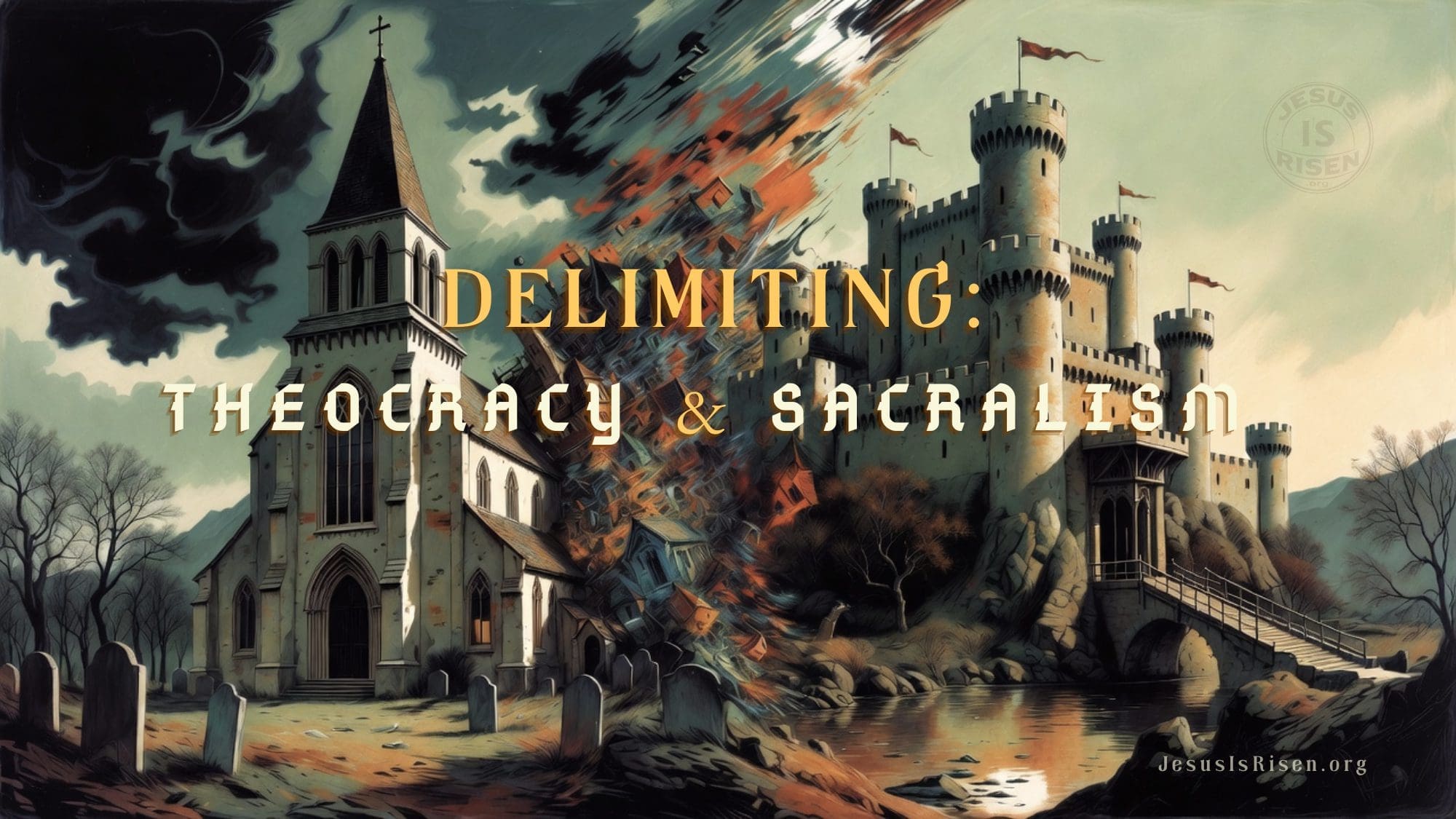
Delimiting: Theocracy & Sacralism
Joining Church & State
To “rule by God” is the implication of theocracy — sacralism extends that rule to the state by mutual usurpation: the state claiming the church’s keys, the church claiming the state’s sword. Together, these two concepts have shaped the last two millennia of Christian civic and political discourse — and are among the most misunderstood today.
As a people we suffer from historical amnesia — believing our generation is the first to discuss how a nation can be Christian, and assuming that when previous generations did so, they did it flawlessly. We romanticize Christendom, spit out the bones, forget we nearly choked to death on them. In counter-signaling Progressives on the Crusades, Inquisitions, and Colonialism, we’ve over-corrected and built a modern hagiography of our ancestors. The danger is not only that we ignore the victims — often other believers — but that we disregard the sanctifying work of Christ on His Church over time.
This series seeks to delimit the key concepts — theocracy and sacralism — by distinguishing the manner, scope, and limits of divine appointment, so claims to authority can be properly understood and evaluated without inherited assumptions clouding the view.
Inheritance and Continuity
By way of orientation, my own history reflects this inheritance. I am the 11th great-grandson of Puritan survivors of the Plymouth Colony, who fled England to escape a sacral system in which Christians persecuted other Christians by the power of the state. I was also formed within late-twentieth-century American evangelicalism — specifically the homeschooled, Free Methodist, conservative evangelical stream of the 90s Religious Right era. I was already picking sides as a kid — listening to Bob Dutko on WMUZ, reading The Light and the Glory, immersed in Creation Science debates — long before the present Christian Nationalism framing existed.
A new generation has arrived — many of them my generation, probably not paying attention — acting like this is a new conversation. It isn’t.
Indeed, as we’ll demonstrate, this conversation is as old as the church. Many of the errors we’re making now predate nationalism itself and long before anyone paired it with Christian.
Hermeneutics of Christian History
A hermeneutic is an interpretive method. While most often applied to Scripture, it is equally necessary when reading history. Modern categories imposed on past societies obscure how authority, belief, and practice actually functioned in their own contexts.
This problem is especially acute in Church history. Christians often read earlier periods as theological darkness or moral failure — as though the Church’s faithfulness were intermittent or only recently rediscovered. Scripture rejects that framing:
- One gospel once for all delivered to the saints (Jude 3)
- Christ’s promise that the gates of Hades will not prevail against His Church (Matt 16:18)
- The certainty that God’s word always accomplishes its purpose (Isa 55:11)
A proper historical hermeneutic therefore affirms real continuity without denying real failure. The Church’s history is neither uninterrupted progress nor prolonged apostasy, but a record of preservation marked by growth, correction, error, and reform. Christians in every age operated within inherited political and cultural assumptions that shaped how authority was understood and exercised.
Recognizing this continuity allows us to account for both faithfulness and abuse without romanticizing the past or dismissing it, and guards against mistaking inherited authority structures for biblical mandates.
What Is a Theocracy?
A theocracy is a state which either has been, or claims to be, instituted by God to rule.
According to Scripture, there is only one people whom God directly instituted as a theocracy: the peoples of Ancient Israel. Only Ancient Israel had civic government (Moses, Joshua, Judges, Monarchy), church government (Levitical Priesthood), and laws all instituted by God. That said, many states — believing and unbelieving — have claimed divine warrant or constitution and therefore qualify descriptively as theocracies, even when we do not recognize their warrant as legitimately divine.
Theocracies in History
Notable examples commonly cited include Ancient Israel; the Papal States; the Prince-Bishoprics of the Holy Roman Empire; Calvin’s Geneva (in its civil–ecclesial arrangements); Puritan Massachusetts Bay; the Tibetan government under the Dalai Lamas; and the Islamic Republic of Iran.
Historically, rulers justified such claims through lineage, clerical sanction, or asserted divine right — attempting to counterfeit the divine decree that alone constituted legitimacy in Ancient Israel. Yet these claims rest on authority never delegated. To rule in accordance with God’s law — executing its prescribed sanctions — is distinct from ruling as God in matters of inward worship and conscience. John Knox named this error plainly: when rulers claim divine or covenantal authority not granted by God, they become tyrants and idolaters, usurping an office that belongs to God alone (Knox, 1558).
What Is NOT a Theocracy?
In defining theocracy, note what is absent: an ethical standard for rule. Basing your laws on a moral (even divinely revealed) standard does NOT make a government theocratic. A theocracy is dependent on the source of said government’s claim to authority, not on the standard by which they rule.
Sacralism
Sacralism goes beyond a general claim of divine authority by confusing the distinct spheres of authority God has ordained for civil and ecclesial rule — spheres equipped with different instruments for different ends:
- The civil magistrate is God’s servant bearing the sword to execute penal sanctions where God’s law attaches them, punishing outward violations of both tables — duties to God in the first and to neighbor in the second — and promoting external righteousness as nations are summoned to serve the Lord with fear (Rom 13:1–4; Ps 2:10–12).
- The church is entrusted with the keys of the kingdom to govern doctrine, worship, and conscience inwardly through the ministry of Word and sacrament — declaring guilt, withholding absolution, and delivering to Satan the impenitent, yet never wielding physical coercion (Matt 16:19; 18:15–20; 1 Cor 5:1–5; John 20:23).
Sacralism arises when the civil state not only appeals to God for legitimacy but usurps ecclesial functions never delegated to the sword: compelling inward faith, enforcing doctrinal conformity beyond revealed crimes, regulating private worship, or binding conscience directly rather than punishing outward acts. Church and state fuse, each legitimizing the other, so that political power enforces religious uniformity beyond scriptural warrant and religious authority bends to political pressure.
This fusion emerged gradually in Christian Europe from the fourth century onward and became normalized in medieval Christendom; analogous patterns appear wherever religious authority legitimizes political power and political power enforces belief.
Early Sacral Precedent
The logic of sacralism did not emerge fully formed in the medieval period. It took root in isolated moments when civil authority was enlisted to resolve church conflict. One such moment occurred during the Donatist controversy — a dispute over the legitimacy of clergy who had compromised under persecution. What began as a theological disagreement escalated into civil unrest, church councils, and ultimately state enforcement.
With Augustine’s support, imperial power was used to compel unity, treating civil coercion as an instrument of divine correction. In doing so, the state was drawn into adjudicating church legitimacy and enforcing religious conformity — an early instance of jurisdictional confusion that would later harden into full sacral systems. This marked the beginning of fifteen centuries of precedent that would only begin to crumble with the Reformation.
The Reformation inherited this sacral framework — but it also began to crack it open. The early Reformers did not immediately abandon the fusion of spheres; they carried it forward even as they challenged Rome. Yet the doctrinal fractures they introduced would eventually force the question.
The Magisterial Reformers’ Inheritance
The early Reformers inherited a sacral world. Though they challenged papal authority and recovered essential doctrines, they often retained the assumption that the state could and should enforce religious uniformity.
Thus the same men who defied Rome at the risk of death authorized imprisonment and execution of dissenters. Calvin’s Geneva, Lutheran territories, and Reformed cities all disciplined conscience with the sword. They were products of their times. That lens may help us better understand the failures, successes, and sacrifices made on our behalf.
The Anabaptists
While the magisterial Reformers retained much of the sacral inheritance, the Anabaptists exposed its assumptions with unusual clarity. In much of Europe, baptismal records functioned as civil registries. To refuse infant baptism was not merely theological dissent; it was civil disobedience.
By rejecting infant baptism and practicing believer’s baptism, Anabaptists effectively withdrew from the sacral order. Authorities — Protestant and Catholic alike — treated this as treason. Men and women were imprisoned and executed, often with the explicit approval of Reformers.
Fritz Erbe
The case of Fritz Erbe illustrates how deeply sacral assumptions endured even among reformers of conscience. Erbe, a peasant farmer from Herda near Eisenach, was first arrested in 1531 for receiving believer’s baptism but briefly released in 1532. In 1533, he refused to baptize his newborn son — an act deemed heresy and sedition under the 1529 Diet of Speyer edict, which mandated death for Anabaptists without ecclesiastical trial.
Initially confined in Eisenach’s Stork Tower, he was transferred around 1540 to Wartburg Castle’s underground dungeon, a cold, dark, damp “terror hole” accessible only by rope. There he was left to rot, deprived of light and warmth, his health ruined over years of isolation. Lutheran pastors debated him to force recantation, but he stood firm. Erbe died in 1548 after nearly fifteen years of imprisonment, buried beneath the castle walls.
Luther’s approval deepened the irony. Only a decade earlier, in 1521, Luther had hidden at Wartburg after defying the Diet of Worms with his famous stand: “My conscience is captive to the Word of God — recant or die.” Yet Luther co-signed the 1536 Opinion on the Anabaptists, urging princes to wield the sword against them as blasphemers causing tumult (Luther, 1536, as cited in Daniels, 2024). In his 1530 Letter to the Princes of Saxony, he called for rooting out Anabaptist doctrines with force (Luther, 1530, as cited in Daniels, 2024). This shift exposed the limits of Reformation conscience: honored within confessional bounds, crushed beyond them.
For more on Erbe and the Diet of Speyer, see Daniels (2024). For a comprehensive Reformed Baptist treatment of church history including the Anabaptists, Luther’s stance, and the broader Reformation context, see White (2016–2018).
Schism of State
Sacralism was woven into the culture. The Reformation did not immediately end it — but it initiated a rupture that sacral systems could not ultimately survive. The schism of the Reformation was not confined to individual conscience or ecclesial allegiance; it was translated directly into the structure of the state itself.
Under sacral assumptions, the state had long functioned as a guarantor of religious unity. Civil authority presupposed a singular church whose doctrine it could enforce, defend, and institutionalize. The Reformation shattered that presupposition. Once rival confessions claimed fidelity to Christ within the same political order (starting in the Holy Roman Empire, and quickly expanding across Europe), the state was forced into a question it had never been situated to answer: Which Church is legitimate?
If the state ruled as God — as sacral logic required — it now had to adjudicate theological truth between competing churches. Yet the civil magistrate possessed neither a separate special revelation nor covenantal jurisdiction to do so. The result was not resolution but escalation. Each confession, when aligned with civil power, sought to suppress the others in the name of order, producing cycles of repression, war, and bloodshed.
This moment exposes the internal contradiction of sacralism. A system that depends on religious singularity cannot endure doctrinal fracture without coercion. The Reformation revealed that sacral authority could be preserved only by the sword — and in doing so laid bare its structural limits. It is here that Scripture’s own boundaries become decisive.
Render to God What Is God’s: Limitation
Jesus’ words — “Render to Caesar what is Caesar’s, and to God what is God’s” — establish not only obligation, but boundary. Romans 13 affirms civil authority, yet also limits it. Taxes, honor, and obedience are due; conscience, worship, and divine authority are not.
When the state assumes the authority of God or the church, what is due becomes confused. The sword, entrusted for justice, is turned toward conscience. Sacral systems celebrate this confusion as order. Scripture condemns it as usurpation. This article therefore distinguishes sacralism from other views that seek to limit civil authority by Scripture.
Summary
This article delimited theocracy and sacralism to clear the ground for faithful reflection on civil authority and divine appointment, free from romanticized assumptions or undefined terms.
A theocracy is a state claiming divine institution; Scripture recognizes only Ancient Israel’s as legitimate, while others qualify descriptively.
Sacralism confuses spheres: the magistrate’s sword for outward penal sanctions (both tables) versus the church’s keys for inward governance of doctrine, worship, and conscience. Fusion leads to tyranny — one sphere invading another’s delegated realm.
The Reformation exposed sacralism’s internal contradiction: the state cannot adjudicate theological truth without coercion. This rupture matters because it initiated the reform of church and state relations — a process the next article will examine: how some Reformers came to see the necessity of distinguishing the spheres more sharply, and why that distinction is not the secular neutrality or radical bifurcation many today assume.
References
Augustine. (ca. 405). Letters (Letter 93). In P. Schaff (Ed.), Nicene and post-Nicene fathers (1st ser., Vol. 1). Hendrickson. (Reprinted 1990)
Charlemagne. (ca. 789–814). Capitularies. In H. R. Loyn (Ed.), The reign of Charlemagne: Documents on Carolingian government and administration. Edward Arnold. (Reprinted 2004)
Daniels, J. N. (2024). Fritz Erbe: A martyr of conscience in Luther’s shadow. Irish Baptist (Substack). https://substack.com/home/post/p-172332081
Justinian. (529–534). Corpus juris civilis. In P. Krueger & T. Mommsen (Eds.), Corpus juris civilis (Vol. 2). Weidmann. (Reprinted 1985)
Knox, J. (1895). The Appellation from the sentence pronounced by the bishops and clergy (1558). In D. Laing (Ed.), The works of John Knox (Vol. 4, pp. 465–520). James Thin. (Original work published 1558)
Knox, J. (1895). A godly letter directed to the faithful in London (1554). In D. Laing (Ed.), The works of John Knox (Vol. 3, pp. 161–216). James Thin. (Original work published 1554)
White, J. (2016–2018). Church History [Sunday School series]. Phoenix Reformed Baptist Church. https://www.sermonaudio.com/series/25673
Liked what you read? Subscribe for free.
Never miss out — Be notified of my latest articles!