Marriage, Murder, & Mahler
A Biblical Judgment on Bloodguilt and Marriage
A legally married couple brought before a judge, found guilty, and put to death in Christ’s name. Why? Because of God’s providential ordering of their bloodlines.
That is not a hypothetical. Corey J. Mahler — once a Lutheran pastor, now defrocked and unrepentant — has publicly declared, “Under Christian Nationalism, interracial marriage will be made a capital offense.” The original tweet has reached tens of thousands alone, and is shaping conversations across the world.
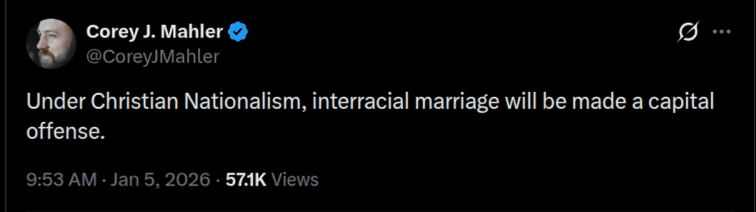
The problem is not only offensive rhetoric. Mahler is advocating for the state to execute innocent people in God’s name. By invoking “Christian Nationalism”, Mahler is implicitly invoking God’s law. In doing so, Mahler attributes to God a law He hasn’t given, and in doing so profanes God’s name. God’s law exists to restrain evil, not to promote it; protect good, not abuse it (Rom 13:1-7).
This article stands to clarify and define terms while drawing a line in the sand. God’s law doesn’t need excuses, it needs to be upheld. For Mahler and the other ethno-nationalists, Kinists, and partialists, God’s law is not their cudgel.

Christian Nationalism
A majority of the weight of Mahler’s argument rests on Christian Nationalism — So we’re going to kick it out from under him.
The underlying conflict is over what it means to call a nation Christian, and what such a nation may lawfully do. This article is not an argument for Christian Nationalism as a political program, but an examination of whether claims made in its name can be squared with God’s law. For those who read the Cultural Mandate (Gen. 1:28) and the Great Commission (Matt. 28:18–20) as standing obligations, these questions cannot remain abstract.
Christians have not ceded the world to the enemy; Christ rules now, from heaven, over the nations (Ps. 110; cf. 1 Cor. 10:25). What we believe about authority, law, and jurisdiction directly shapes the future we are building and the limits we place on civil power.
The elephant in the room that practically nobody ever mentions is that there is no single Christian Nationalism. If you’re a Christian Nationalist, breathe. This critique is not of the term itself, but of a failure to properly label distinctions. Christian Nationalism functions as an umbrella term describing a range of diverse and often competing views. Mahler’s proposal doesn’t reflect mainstream populist usage of the term — and even many Kinists reject (as we’ll soon demonstrate).
Even if there is no single Christian Nationalism, the name itself implies certain shared assumptions: a nation ordered in some sense as Christian. Disagreement arises over how those terms relate, but broadly speaking Christian Nationalists envision a nation-state that, in some form, respects or orders itself according to God’s Word or law.
Ethno-Nationalism: “White Christian Nationalism”
What Mahler calls “Christian Nationalism” is better understood as Ethno-nationalism. It is occasionally referred to as “White Christian Nationalism” by critics and proponents alike, though this is less precise — ethno-nationalism isn’t restricted to any given ethnic group.
If there is any doubt, one only needs to look towards these two exchanges between Jay Anytelo and Brian Suave over Mahler’s post. Suave was given the opportunity to differentiate how ethno-nationalism and his views of Christian Nationalism were substantially different, and he offered Kinism doctrine without the label.
Kinism is a heresy which integrates ethno-nationalist views. Among its many errors, Kinism redefines biblical concepts of nation, tribe, people, and flattens them all to mean “bloodlines” — something the Bible doesn’t actually do.
Ethno-nationalists interpret “nationalism” to mean a distinct ethnic, familial, kin, or tribal group (think “racial” if using secular humanist terms). Both “nation” and “nationalist” have broad meanings and this is where ethno-nationalists (and Kinists) take advantage of the ambiguity.
Nations, According to Scripture
Scripture does not treat “nations” as racial bloodlines but as peoples under law. As the International Standard Bible Encyclopedia notes, Gentiles in Israel enjoyed legal protection, asylum, inheritance rights, participation in worship, and full civil standing — categories wholly incompatible with racialized conceptions of nationhood.
Kinist and other partialist influencers rely on widespread biblical illiteracy to sustain their claims. Because many readers are familiar only with strained Jewish–Gentile relations in the New Testament, it is often assumed this posture was timeless and normative. Yet Scripture itself — and Christ’s own interactions with Gentiles — demonstrate otherwise.
Under Old Testament regulations they were simply non-Israelites, not from the stock of Abraham, but they were not hated or despised for that reason, and were to be treated almost on a plane of equality, except certain tribes in Canaan with regard to whom there were special regulations of non-intercourse. The Gentile stranger enjoyed the hospitality of the Israelite who was commanded to love him (Deuteronomy 10:19), to sympathize with him, “For ye know the heart of the stranger, seeing ye were strangers in the land of Egypt” (Exodus 23:9 the King James Version).
Read the full section from the International Standard Bible Encyclopedia on “Gentiles,” for a fuller treatment. Far from being Pariah, there were other nations who intermixed with Israel, and, often made sacrifices, and entered into the covenant with Israel.
The Griff: Communication Tactics
Mahler likely believes he is a Christian Nationalist. Ethnic partialists typically do. Because there is no formal authority defining the term, exclusion on semantic grounds alone is insufficient. The issue is not self?identification but standard: God’s Word. Any movement or doctrine that cannot withstand biblical scrutiny cannot rightly claim the name Christian and must instead be identified, plainly, as heresy.
This is the function of the grift: the deliberate attachment of heretical or cultic doctrines to orthodox names in order to borrow their legitimacy. Kinism, Christian Identity, Latter?Day Saints, Jehovah’s Witnesses, and similar movements all employ this tactic deliberately and strategically.
Unorthodox Parasite
Such groups attach themselves to the public names and symbols of orthodox Christianity so that legitimacy transfers asymmetrically. In this way, figures like Mahler present themselves as voices of Christian Nationalism in order to co?opt public trust associated with Christianity and its political expressions.
If he had written,
Under the Klan, interracial marriage will be made a capital offense.
Few, if anyone, would have batted an eyelash. By associating the claim with Christian Nationalism, Mahler fused shock value with borrowed religious legitimacy, allowing the outrage economy — this article included — to amplify his claim far beyond what candor ever could, as perceived legitimacy attached to a shared name enables claims to travel farther, faster, and with less scrutiny than they otherwise could.
Yet, this begs the question we must answer: Under Christian Nationalism would it be unlawful for a couple of mixed people groups to marry?
The Church’s Biblical Role
The role of the church is to speak prophetically against false doctrine — especially when such doctrine is taught publicly, claims divine authority, and calls for concrete acts of civil violence. Silence in the face of such claims is not neutrality but abdication.
With this all established, we will bring the law of God to bear against Corey Mahler’s claim:
Under Christian Nationalism, interracial marriage will be made a capital offense.
The Case
- The Image of God — Both man and woman are created as image bearers of God, equal in Adam and equal in Christ (Gen. 1:26–27; Gen. 9:6; Rom. 5:12-21).
- United in Christ — Any separation which may have divided mankind apart from Christ has been resolved in Christ (Acts 17:27, Gal. 3:28; Col. 3:11; Eph. 2:14–16).
- Covenant of Marriage — Marriage is an ordinance established at creation with the intent to mirror the relation of Christ and the Church (Gen. 2:24; Eph. 5:31–32).
- The Symbol — It would be incoherent for marriage to be guilty of death for representing physically what Christ has accomplished spiritually.
- Profaning Marriage — In calling such couples and such marriages guilty of death, Mahler, and those who praise him, are profaning the ordinance of marriage. (Mk 10:9)
- Profaning God — Such a claim is not merely the teaching of false doctrine, but the profaning of God and His good character; of His Law; and of His covenant by rendering Christological image judicially unclean.
- Shedding of Innocent Blood — Not only is all of this an abomination before God, but Mahler proposes the shedding of innocent blood in God’s name.
Mahler’s Liability Under God’s Law
Scripture explicitly forbids adding to God’s law or attributing commands to Him He did not speak (Deut. 4:2). Those who publicly lead others after false law or speak in the name of Yahweh what He has not commanded are subject to the severest covenantal and civil judgment (Deut. 13:1–5; Deut. 18:20).
It is not merely a matter of false doctrine, but pairing that false doctrine with shedding innocent blood. For someone like Joel Webbon to reframe this entire discussion as a polite intercollegiate debate — It’s not — intellectually dishonest at best, ethically culpable at worst. Mahler is a man claiming pastoral authority advocating for state sanctioned murder of innocent people in Christ’s name. Full stop.
The ship for “friendly intramural rhetoric” has long since sailed, sunk, and is now crying out for justice.
Scripture assigns guilt not only to the executioner, but to those who authorize, teach, or normalize such injustice (Deut. 27:25; Isa. 10:1–2; Prov. 6:16–17). Bloodguilt in God’s law attaches upstream — to false prophets, corrupt judges, and those who normalize unrighteous decrees — the moral and juridical liability rests not on innocent persons imagined as offenders, but on those who falsely legislate in God’s name (Num. 35:33; Jer. 23:14).
Therefore, according to God’s law, Corey J. Mahler would be liable for bloodguilt if he were ever foolish enough to advocate for the capital punishment of couples married in a theonomic society — and given how the wind blows, even in a sacral society.
Coram Deo
Before the Face of God
God’s law is good, holy, and just. It is not an artifact of the Old Testament, thrown away for us to disregard. Christ fulfilled its righteous requirements, not as some unclean and evil thing, but as a holy and good thing we, as Christians, have no reason to fear. We are not saved by the law, but the law remains our standard of justice, morality, and ethics (Rom. 7, 1 Tim 1:8). It is by God’s grace we can joyfully be obedient without fear of punishment (Rom. 7; 1 Tim. 1:8; cf. 1 John 3:15, 4:18).
There is no ambiguity here: What is being advocated is evil in God’s name. As such, rebuke it in Jesus name.
We tear down speculations and every lofty thing raised up against the knowledge of God, and take every thought captive to the obedience of Christ, and are ready to punish all disobedience, whenever your obedience is fulfilled. (2 Cor. 10:5-6 LSB)
The prophetic role of the Church is to not be timid and weak, but boldly rebuke rebellion clothed as a sheep. That is Christian Nationalism.
Liked what you read? Subscribe for free.
Never miss out — Be notified of my latest articles!